You’ve practiced it. You’ve talked about it. They know the answer.
You ask, “What could you say if you want to join a game?”
They answer, “Can I play too?”
Perfect.
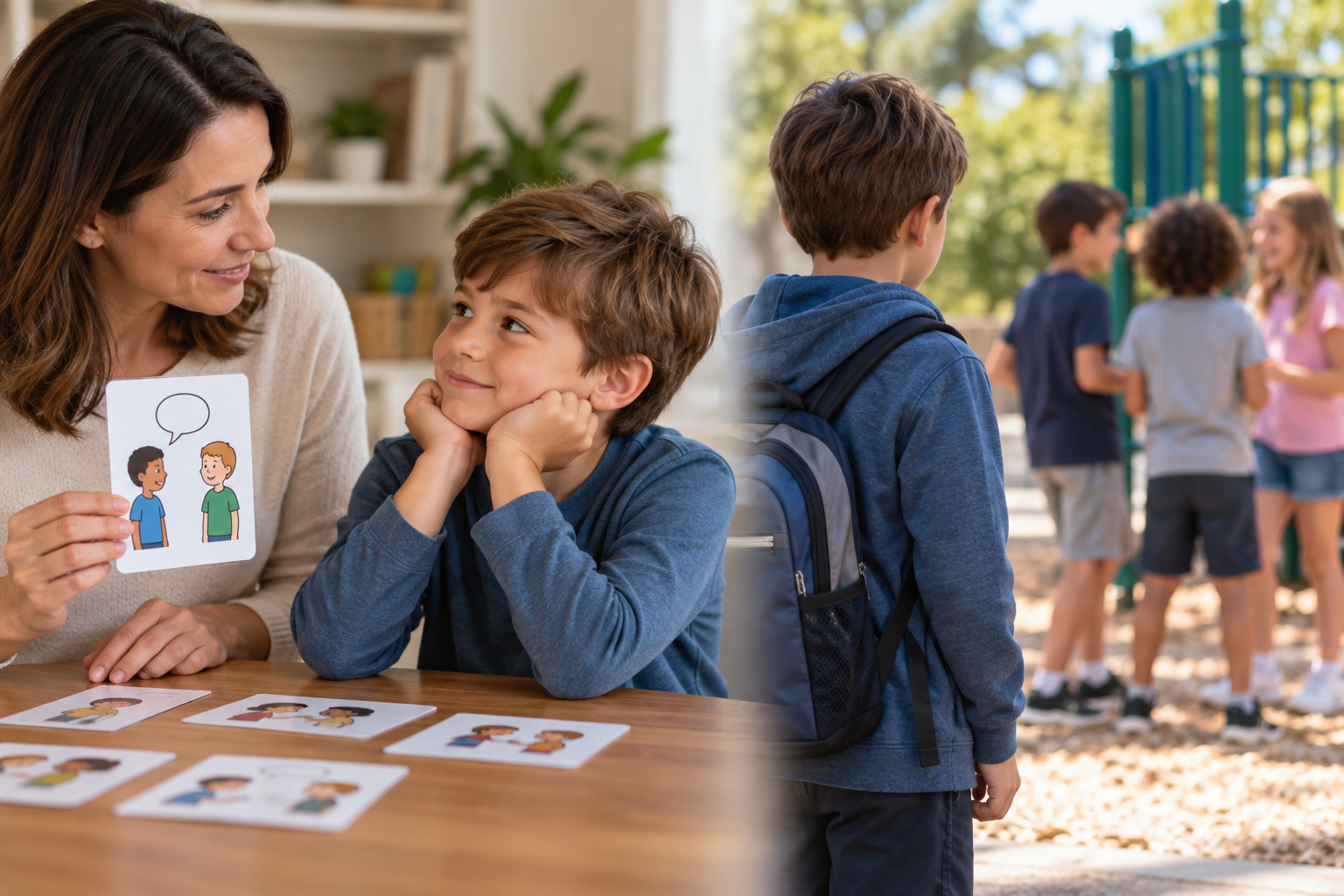
Then you go to the playground. A group of kids is playing. Your child stands nearby, watches for a few minutes, and walks away without saying anything.
Or maybe they know they should ask before taking something, say hello when someone greets them, take turns during a conversation, or tell someone when they’re upset.
When you talk about these situations at home, they know exactly what they should do.
But when the real moment happens, everything seems to disappear.
It can be frustrating for parents, teachers, caregivers, and therapists. You may wonder: If they know the skill, why aren’t they using it?
The answer is important:
Knowing a social skill and being able to use it in the moment are two very different things.
Knowing the Answer Is Only the First Step
Imagine learning to drive by reading a book.
You could memorize what the pedals do, learn every road sign, and correctly answer questions about when to use a turn signal.
But would you be ready to drive through busy traffic?
Probably not.
You would still need practice behind the wheel.
Social skills work in a similar way. A child may understand a skill when sitting calmly with a parent, teacher, or therapist. Real social situations, however, are rarely calm and predictable.
Other people say unexpected things. Conversations move quickly. Someone interrupts. A friend says no. A game suddenly changes. There may be noise, distractions, excitement, embarrassment, frustration, or pressure to respond quickly.
Now the child has to recognize what is happening, remember the appropriate skill, decide whether it fits the situation, and actually use it all within seconds.
That’s much harder than answering a question on a worksheet.
“But We Practiced This!”
And that practice wasn’t wasted.
It gave your child the foundation.
The next step is helping the skill move from “I know what I’m supposed to do” to “I can actually do it when I need it.”
This is sometimes called generalization the ability to use something learned in one situation in other situations.
For example, saying “thank you” during a practice activity is one thing.
Using it with a teacher, a cashier, a grandparent, a classmate, and someone you’ve never met requires more flexibility.
That’s why real-world practice is such an important part of social learning. Capability Connections emphasizes practical activities and real-life application for this reason.
Practice the Same Skill in Different Ways
If we always practice a skill the same way, a child may learn the routine rather than the broader skill.
Suppose you’re working on asking to join an activity.
Don’t practice only:
“Can I play too?”
Change the situation.
What if kids are playing basketball? What if two classmates are drawing? What if someone is playing a video game? What if the group says yes? What if they say, “We’re almost finished”? What if they say no?
Now you’re teaching something bigger than a memorized sentence.
You’re teaching your child how to think through a social situation.
Try asking:
What is happening?
What could you say?
How might the other person respond?
What could you do next?
Those four questions can turn an ordinary situation into valuable social practice.
Give a Cue Without Giving the Answer
Adults naturally want to help.
When we see a child struggling, it’s tempting to immediately say, “Tell her thank you,” “Ask if you can play,” or “Tell him you didn’t like that.”
Sometimes that’s necessary.
But if we always supply the answer, the child doesn’t get the opportunity to retrieve the skill independently.
Instead, try giving a smaller cue.
“What could you say?”
“What do you think you could do next?”
“Remember what we practiced?”
Then wait.
That pause matters. Some children need extra time to process what’s happening and figure out a response.
If they still need help, give another clue. The goal is to provide just enough support for success and gradually reduce that support as the skill becomes easier.
Practice the Unexpected Part
This is something adults sometimes miss.
We practice how to start an interaction but not what happens afterward.
A child practices asking, “Do you want to play?”
Great.
But what happens if the other child says no?
Or says, “Maybe later”?
Or suggests something completely different?
Real conversations don’t follow scripts.
That’s why social practice should include unexpected responses. Instead of practicing one “correct” interaction repeatedly, change what happens.
This helps children learn that they can handle a conversation even when it doesn’t go exactly as planned.
Use Everyday Life as the Practice Room
Social skills don’t have to be practiced only during therapy, school, or a scheduled activity.
Daily life is filled with opportunities.
Ordering at a restaurant can practice speaking clearly and responding to questions.
Going to a store can provide opportunities to ask for help.
A family game can practice waiting, turn-taking, handling disappointment, and being a good sport.
Visiting relatives can provide opportunities for greetings and conversations.
A disagreement with a sibling can become a chance to practice expressing feelings and solving a problem.
These small experiences matter because they happen in the environments where social skills actually need to be used.
Don’t Turn Every Mistake into a Lesson
This one is important.
Imagine if someone analyzed every conversation you had.
“You interrupted there.”
“You should have asked another question.”
“You didn’t look interested.”
“You should have said this instead.”
Most of us would stop wanting to talk.
Children can feel the same way.
Not every awkward interaction needs to become a teaching moment.
Sometimes it’s better to let the situation pass and talk about it later. Choose the moments that matter most and keep the conversation supportive.
You might simply say:
“That looked tricky. What happened?”
Then listen.
You may discover that your child understood exactly what they were supposed to do but became nervous, overwhelmed, distracted, or unsure how the other person would respond.
That information can tell you what to practice next.
Look for Progress That Is Easy to Miss
Success doesn’t always look dramatic.
Maybe your child used to avoid a group completely, and today they stood nearby and watched.
Maybe last month they needed you to tell them exactly what to say, and today they needed only a small reminder.
Maybe they started a conversation but didn’t know how to continue it.
Those aren’t failures.
They’re clues that a skill is developing.
The goal isn’t perfect social performance. The goal is building enough understanding, flexibility, and confidence to navigate everyday interactions with increasing independence.
From Knowing to Doing
When someone struggles to use a social skill, they’ve already learned, repeating the rule louder or more often usually isn’t the missing piece.
They may need more opportunities to practice using that skill in different situations.
Start with structured practice. Change the scenario. Introduce unexpected responses. Practice in everyday environments. Give support when it’s needed, and gradually step back when it isn’t.
Most importantly, remember this:
Knowing the answer isn’t the same as being able to use it when you need it.
That gap between knowing and doing is exactly where practice matters.
At Capability Connections, we focus on practical social communication skills and opportunities to apply them to real-life situations. Our resources are designed to help individuals build skills through structured, supportive practice that can extend beyond the lesson and into everyday life.
Because ultimately, the goal isn’t simply to know the right answer.
It’s to feel prepared when the real moment arrives.