
Many teens want connection more than adults realize. They want friends. They want to feel included. They want to know what to say in social situations and feel comfortable being themselves around other people. But for some teens and young adults, conversations can feel surprisingly overwhelming.
You may notice your teen giving one-word answers, avoiding eye contact, staying quiet in group settings, or shutting down when someone asks a question. Sometimes parents assume their child is uninterested, rude, distracted, or simply “not trying.” In reality, many socially hesitant teens are dealing with something much deeper: uncertainty, anxiety, fear of judgment, or difficulty organizing their thoughts in real time.
For some teens, especially those who are shy, anxious, neurodivergent, or socially inexperienced, conversations can feel like pressure-filled performances rather than natural interactions.
The good news is that communication skills can improve over time especially when teens are given safe, low-pressure opportunities to practice.
Freezing Up Doesn’t Mean a Teen Doesn’t Care
One of the biggest misconceptions about socially hesitant teens and young adults is that they do not want connection. In many cases, the opposite is true.
Some teens care so much about saying the “right thing” that they become mentally stuck. They may overthink their responses, worry about sounding awkward, or struggle to process conversations quickly enough to respond comfortably. Others may feel uncertain about social rules, fear rejection, or simply lack confidence because social interactions have been difficult in the past.
This can create a frustrating cycle. The teen feels anxious, so they participate less. Because they participate less, they gain less confidence and experience. Then future social situations feel even more intimidating.
Parents often notice this pattern during family gatherings, group activities, school situations, or everyday conversations at home. A teen who talks comfortably with one trusted person may suddenly become very quiet around peers or unfamiliar adults.
That does not mean they are incapable of social connection. It often means they do not yet feel emotionally safe or confident enough to participate naturally.
Why Pressure Usually Makes Things Worse
When adults see a teen struggling socially, the instinct is often to “push” communication harder.
“Go talk to them.”
“Just say hi.”
“You need to speak up.”
“Why are you being so quiet?”
While these comments usually come from a caring place, pressure often increases anxiety instead of reducing it.
Many teens and young adults communicate better when they feel relaxed, accepted, and emotionally safe. Conversations tend to flow more naturally when the focus shifts away from performance and toward connection.
That is why low-pressure interaction matters so much.
A teen who struggles to start conversations may actually open up surprisingly well when discussing a favorite interest, answering a thoughtful prompt, or participating in a relaxed back-and-forth activity that removes some of the social pressure.
Small moments of successful interaction matter. They help build confidence and teach the nervous system that communication does not always have to feel stressful.
Social Skills Are Built Through Practice – Not Perfection
Social confidence is not something people magically wake up with one day. Like many life skills, communication develops through repeated experiences, practice, reflection, and emotional safety.
Some teens naturally gain these experiences through friendships, sports, clubs, or frequent social interaction. Others may need more intentional support along the way.
That does not mean something is “wrong” with them.
It simply means they may benefit from guided opportunities to practice communication in a way that feels manageable and encouraging rather than overwhelming.
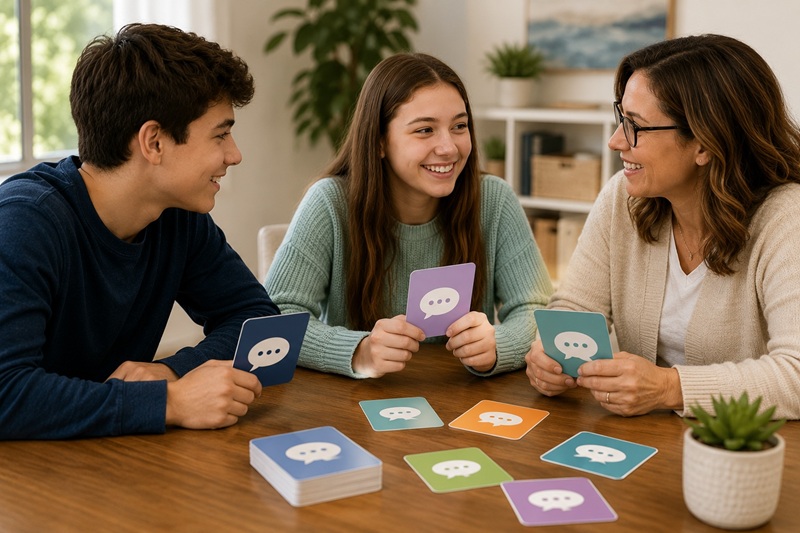
One reason conversation starter activities can be helpful is because they remove some of the pressure of “thinking of something to say.” Instead of staring at a blank social moment, the teen is responding to a prompt that already provides direction and structure.
This can reduce anxiety and help conversations feel more approachable.
Questions like:
“What’s something you could talk about for hours?”
or
“Describe a perfect day out with friends”
often create more natural conversation than direct social pressure like:
“Go make friends.”
The goal is not to force perfect communication. The goal is to help teens become more comfortable expressing themselves little by little.
Neurodivergent Teens Often Experience Social Pressure Differently
Many neurodivergent teens experience social situations differently than their peers. They may struggle with reading social cues, processing conversations quickly, understanding unspoken expectations, or managing sensory overload during interactions.
Some become exhausted by social interaction even when they enjoy being around others. Others want connection but do not know how to enter conversations naturally.
This is why supportive communication tools can be helpful when used in a respectful, low-pressure way.
Rather than trying to “fix” personality traits, the focus should be on helping teens build confidence, self-understanding, communication flexibility, and meaningful connection in ways that feel authentic to them.
Social growth does not have to look the same for everyone.
For some teens and young adults, growth may mean comfortably participating in group discussions. For others, it may mean learning how to maintain a conversation with one trusted friend or feeling more confident speaking up in everyday situations.
Progress matters more than perfection.
Small Changes Can Make a Big Difference
Parents, teachers, therapists, and caregivers can often support communication growth through small everyday changes.
Simple things like:
- allowing processing time before expecting an answer
- asking open-ended questions
- avoiding excessive correction
- creating calm conversation opportunities
- focusing on connection instead of performance
can help reduce pressure and encourage participation over time.
Sometimes the most meaningful conversations happen during low-stress moments like driving in the car, taking a walk, eating dinner, or using conversation prompts together in a relaxed setting.
The goal is to create opportunities for communication without making the teen feel analyzed or judged.
Building Confidence Through Connection
Many socially hesitant teens are not lacking intelligence, personality, or kindness. Often, they are simply carrying anxiety, uncertainty, past social struggles, or difficulty navigating fast-moving interactions.
Supportive communication tools can help bridge that gap by making conversations feel more structured, approachable, and emotionally safe.
At Capability Connections, we create printable social skills resources, conversation starters, and communication tools designed to help teens and young adults build confidence in a low-pressure way. Our goal is to encourage meaningful connection while supporting emotional safety, self-expression, and real-world communication skills.
Sometimes confidence starts with something as simple as one good conversation.