Good conversation skills open doors. They help us make friends, succeed in school, build stronger relationships, interview for jobs, and communicate effectively in the workplace. Whether you’re talking with a teacher, coworker, neighbor, family member, or someone you’ve just met, the ability to start and maintain a conversation is an essential life skill.
For some teens and young adults, however, conversations don’t always come naturally. They may struggle to think of something to say, answer with only one or two words, interrupt without realizing it, or have difficulty keeping a conversation going. Others may avoid social situations altogether because they worry about making mistakes or feeling embarrassed.
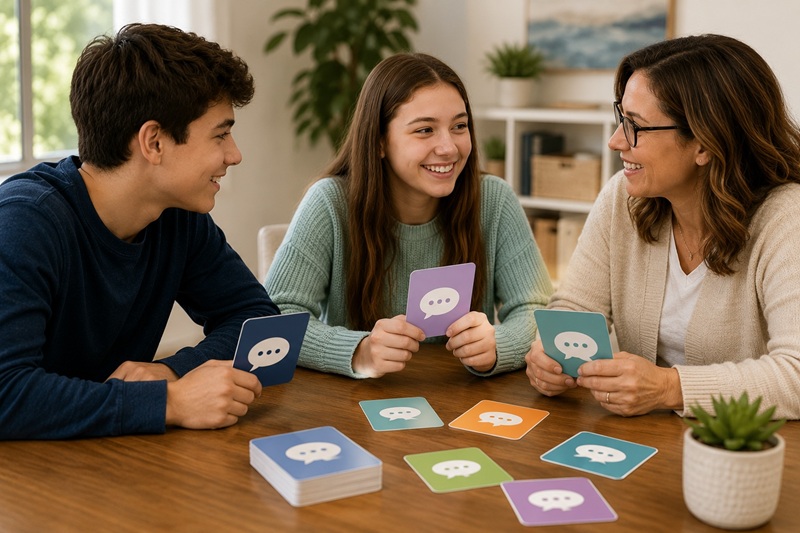
The encouraging news is that conversation skills can be learned and improved with practice. Like any other skill, communication becomes stronger the more it is used. One of the most effective and engaging ways to build these skills is through conversation cards. These simple tools provide structured opportunities to practice speaking, listening, asking questions, and responding to others in a comfortable, supportive environment.
Why Conversation Practice Matters
Many people assume that good conversationalists are simply born with natural social abilities. In reality, most effective communicators have developed their skills through years of experience. Every conversation teaches us something about taking turns, reading social cues, asking questions, and connecting with others.
Without regular opportunities to practice, it can be difficult to gain confidence. This is especially true for individuals with autism, ADHD, learning disabilities, intellectual disabilities, social anxiety, or anyone who finds social interactions challenging. Reading about conversation skills is helpful, but real growth happens through active participation.
Conversation cards create those opportunities by giving participants a reason to talk, listen, and interact with one another. Instead of worrying about what topic to choose, they can focus on practicing the conversation itself.
Building Confidence Through Practice
Confidence isn’t something that magically appears overnight. It develops through repeated positive experiences.
Conversation cards provide a low-pressure way to practice communication. Because the discussion begins with a prompt, participants don’t have to worry about thinking of a topic or wondering whether they’re saying the “right” thing. The card provides direction, making it easier to focus on sharing ideas and responding to others.
As individuals experience successful conversations, they often become more willing to participate in class discussions, speak with coworkers, introduce themselves to new people, or contribute during group activities. Those small successes build confidence that extends far beyond the practice session.
Rather than avoiding conversations, participants begin approaching them with greater comfort and self-assurance.
Strengthening Listening and Conversation Skills
Great conversations involve much more than talking. Listening carefully is equally important.
Conversation cards encourage participants to pay attention to what others are saying before responding. Instead of simply waiting for their turn to speak, they learn to ask follow-up questions, make comments related to the discussion, and show genuine interest in another person’s thoughts and experiences.
These skills help conversations feel more natural while teaching important habits such as taking turns, staying on topic, and responding appropriately.
Participants also learn that conversations are shared experiences. The goal isn’t to give the perfect answer but to create an enjoyable exchange where both people feel heard and respected.
Learning How Conversations Naturally Flow
One common challenge is knowing how to keep a conversation going after the first question has been answered. Many people give very short responses and unintentionally end the conversation.
Conversation cards provide repeated opportunities to practice expanding answers, asking questions in return, sharing related experiences, and smoothly transitioning between topics. Over time, these skills become more automatic.
Participants begin recognizing that good conversations are built through curiosity, active listening, and genuine interest in the other person. Instead of memorizing scripts, they learn flexible communication skills they can apply in everyday situations.
Encouraging Critical Thinking
Many conversation prompts require more than a simple yes-or-no answer. They encourage participants to explain opinions, compare ideas, solve problems, imagine different situations, and consider multiple perspectives.
These discussions strengthen critical thinking while improving verbal communication. As individuals organize their thoughts before speaking, they develop stronger reasoning skills and become more comfortable expressing themselves clearly.
Learning to explain ideas respectfully, even when opinions differ, is an important life skill that benefits school, work, friendships, and family relationships.
Supporting a Variety of Learners
Conversation cards are flexible enough to meet individuals where they are. They can be adapted for different ages, communication levels, and learning styles, making them valuable tools for teachers, therapists, parents, caregivers, and job coaches.
For individuals who become anxious during unstructured conversations, the predictable format of conversation cards can reduce stress while providing clear expectations. Instead of wondering what to say next, participants can focus on practicing eye contact, listening, conversational turn-taking, and responding appropriately.
Because every learner has different strengths and challenges, conversation cards can easily be modified to provide additional support or greater independence as skills improve.
Choosing the Right Conversation Cards for Your Goals
Not all conversation cards are designed to teach the same skills. Some focus on helping individuals start conversations, while others encourage deeper discussions, problem-solving, or practicing appropriate responses in everyday situations. Choosing conversation cards that match your goals can make practice more meaningful and engaging.
At Capability Connections, we’ve created a variety of printable conversation resources designed to support different aspects of social communication.
Our Conversation Starter Cards help break the ice and encourage meaningful discussions by providing engaging prompts that are easy to answer.